Illustrated Strategy Guide
How to Solve a Sliding Puzzle
A clear, illustrated 5-step method that solves every 3x3, 4x4 (15-puzzle), and 5x5 sliding tile puzzle without memorizing long formulas.
The Short Answer: Solve Layer by Layer, Never Tile by Tile at the End
To solve any 3x3, 4x4 (15-puzzle), or 5x5 sliding puzzle reliably every single time, finish the top row completely, then the second row, then reduce the final two rows column by column from left to right until only a 2×2 corner remains. The one secret that prevents getting stuck is placing the last two tiles of any row or column together using the corner-parking trick instead of dropping them in one by one.
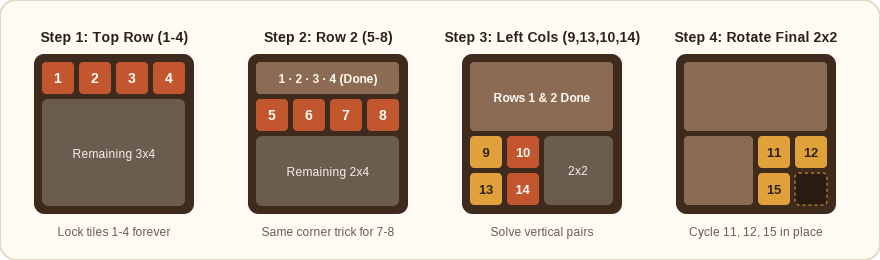
Step 1: Solve the First Row Left to Right (Except the Last Two Tiles)
On a 4×4 board, your first goal is locking tiles 1, 2, 3, and 4 along the top edge.
- Move 1 directly to the top-left corner (
row 1, col 1). - Move 2 directly next to it (
row 1, col 2). - Stop before placing 3 in its final slot. If you park
3inrow 1, col 3while4is still down below, you will trap yourself when trying to slide4into the top-right corner.
Step 2: Use the Corner-Parking Trick for the Last Two Tiles (3 and 4)
This single 4-move pattern is the most important technique in every sliding tile puzzle—learn it once and you can solve 3×3, 4×4, 5×5, and even 10×10 boards.
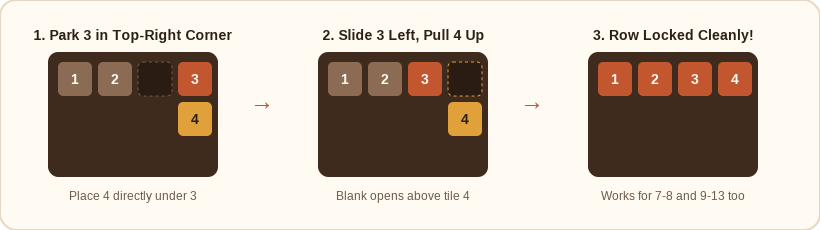
- Move tile 3 into the top-right corner (where
4ultimately belongs). - Bring tile 4 directly underneath tile 3 (
row 2, col 4), taking care not to disturb1or2. - Route the empty space into
row 1, col 3(directly to the left of3). - Slide 3 left into its home slot, then slide 4 straight up into the top-right corner.
What If Tile 4 Gets Stuck Directly Behind Tile 3?
Occasionally 4 ends up trapped in row 1, col 3 while 3 is right next to it in row 1, col 4. To untangle them cleanly without touching 1 or 2:
- Slide
4down into row 2, slide3left intorow 1, col 3, and move the blank below3. - Push
4out toward the middle of row 3, park3back in the top-right corner (row 1, col 4), and bring4around underneath3cleanly.
Once 1, 2, 3, 4 sit across row 1, never touch row 1 again. You have reduced a 4×4 puzzle to a simpler 3×4 puzzle.
Step 3: Repeat for Row 2 (Tiles 5, 6, 7, and 8)
Treat row 2 as the new "top row" of your remaining 3×4 grid:
- Place 5 and 6 into the first two slots of row 2.
- Park 7 in the right-hand slot of row 2 (
row 2, col 4) with 8 directly underneath it (row 3, col 4). - Clear the slot left of
7, slide7left, and pull8up into place.
Rows 1 and 2 are now permanently solved. Only the bottom 2×4 strip (tiles 9, 10, 11, 12, 13, 14, 15 and the empty space) remains.
Step 4: Solve the Bottom Two Rows Column by Column
You cannot solve row 3 horizontally without scrambling row 4. Instead, turn the exact same corner-parking trick 90 degrees sideways and solve the leftmost vertical columns one at a time:
- Lock Column 1 (
9and13):- Park 9 temporarily in the bottom-left corner (
row 4, col 1, where13belongs). - Bring 13 directly to the right of 9 (
row 4, col 2). - Move the empty space into
row 3, col 1(above9), slide 9 up into its home slot, and slide 13 left into the bottom-left corner.
- Park 9 temporarily in the bottom-left corner (
- Lock Column 2 (
10and14):- Park 10 in
row 4, col 2, place 14 to its right inrow 4, col 3, clearrow 3, col 2, then slide10up and14left.
- Park 10 in
Step 5: Cycle the Final 2x2 Square (Tiles 11, 12, and 15)
Only three tiles (11, 12, and 15) and the empty slot remain inside the bottom-right 2×2 corner. Rotate those three tiles clockwise or counter-clockwise around the square—within at most 6 moves, every tile will click into solved order!
Why Are My Final Two Tiles Swapped?
If you followed every step accurately and end up with 11, 12, and 15 in the wrong cyclic order (for example, only two tiles swapped on the entire board), that starting arrangement is mathematically unsolvable. Half of all randomly reassembled physical puzzles have invalid parity. Test your board in our Sliding Puzzle Solver to check its parity instantly.
How This Method Scales to 3x3 and 5x5 Boards
- 3x3 Sliding Puzzle (8-Puzzle): Skip straight to Step 2 for row 1 (
1, then park2and3), then do Step 4 for column 1 (4and7), and finish the final 2×2 (5, 6, 8). Practice on our 3x3 Sliding Puzzle. - 5x5 Sliding Puzzle (24-Puzzle): Solve rows 1, 2, and 3 horizontally (always parking the last two tiles of each row together), then solve columns 1, 2, and 3 of the bottom 2×5 strip vertically, and rotate the last 2×2 corner. Try it right away on Sliding Tile Puzzle.
Frequently Asked Questions
What is the easiest way to solve a sliding puzzle?
Solve the top rows one by one from left to right (using the corner-parking trick for the last two tiles of each row), then solve the remaining bottom two rows column by column from left to right, and finally rotate the last 2x2 square into place.
How do you place the last two tiles in a row of a sliding puzzle?
Park the second-to-last tile (such as 3) in the far right corner, move the final tile (4) directly underneath it, bring the empty space to the left of 3, then slide 3 left and 4 straight up into the corner.
How do you solve the last two rows of a 4x4 sliding puzzle?
Never try to solve the third row horizontally on a 4x4 puzzle. Instead, solve the bottom two rows vertically column by column: place 9 and 13 together in column 1, then 10 and 14 in column 2, leaving only three tiles in the bottom-right 2x2 corner.
Why are my last two tiles always swapped?
If every tile except one pair (like 14 and 15) is solved, the board has impossible parity and cannot be solved by legal moves. Double-check whether two physical tiles were swapped, or verify the board in our Sliding Puzzle Solver.